Building a frontier studio in public journal, #01
This is the first post of a series where we document creating a frontier studio in real time. No waiting until we’ve “made it” to share the raw process and behind-the-scenes as it happens.
In this one, let’s talk quantum physics, our brand thesis rendered as geometry and the difficulty of positioning a new kind of studio tailored for the 2030s. Grab a coffee!
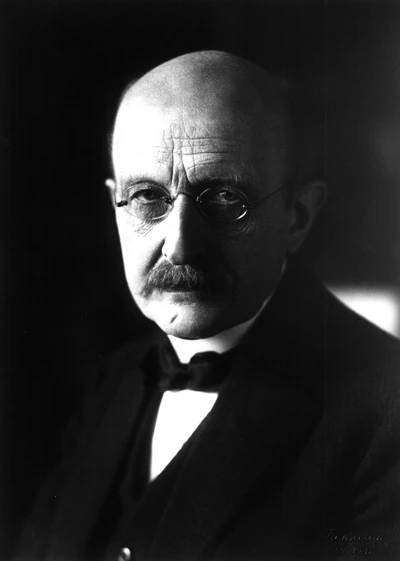 Max Planck, c. 1930. The original quantum leap of faith.
The threshold
Today is 14/04/26. World Quantum Day. April 14th refers to 4.14, the rounded first digits of Planck’s constant: 4.1356677 × 10⁻¹⁵.
This number cracked open quantum mechanics a century ago. It opened new opportunities in every field.
Planck discovered that energy does not flow in a smooth line. It comes in packets, and below a certain threshold, the packet does not exist. It is not small. It is… nothing.
There is a similar threshold in the work we care about. Below a certain level of attention, output looks fine, it functions, checks all the boxes and reaches the ultimate goal: maximising shareholder value. But it often means nothing, too. You can feel it. You experience it every day.
At MWC in Barcelona this year, I saw billion-euro companies displaying early ChatGPT-generated images on 4K screens at their stands. The one with the yellow “piss” filter and this uncanny feeling. These outputs would already be considered slop by mid-2024, on displays that cost more than a car in 2026. That is below the threshold.
We started this studio to stay as much as we can above that line.
I could have written about tools, workflows we used to create this website, the latest shiny AI model we had to optimise and link to our Obsidian knowledge base, or our infrastructure. Or I could have made a simple carousel about our offers. That would have been quicker. It would have performed better.
No, instead my internal voice told me to write about tesseracts and quantum physics, a domain I’m still struggling to grasp. I was a very bad physics and mathematics student at school. I feel like I failed my first physics teacher, Ms. Mass (you can’t make these things up), but I’m starting to slowly catch up again.
So why does an unknown, pre-revenue studio in Barcelona have 4D tesseracts, a white hole, and quantum particle animations all over its website? By all traditional marketing and conversion advice, this is a kamikaze move.
Think of the SEO. How many leads will this get us? Who is searching in Google for “Tesseract Growth Barcelona”? Nobody ever, probably. But we did it anyway with that in mind for a reason.
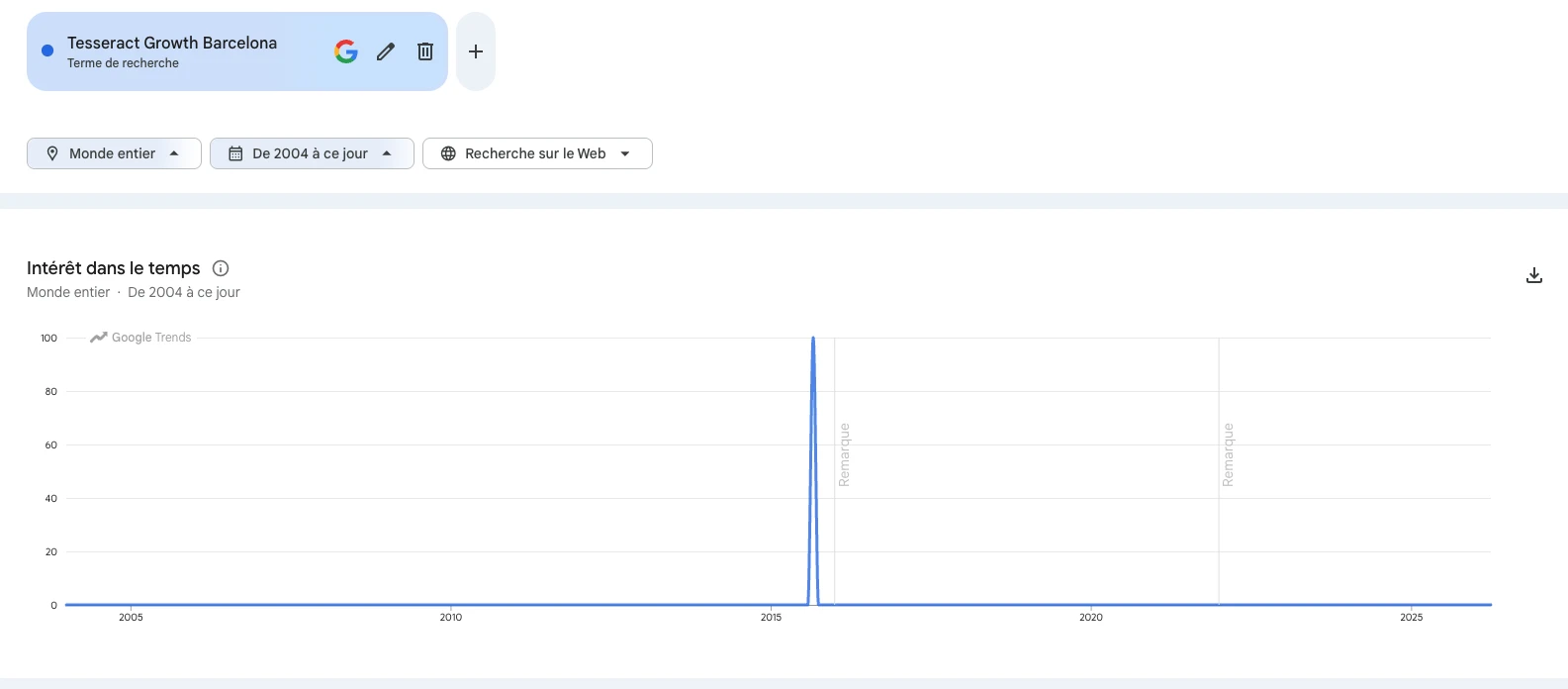 Google Trends, 2004-2026. “Tesseract Growth Barcelona”: one person, once, in 2015. Who are you? We
need to talk.
Google Trends, 2004-2026. “Tesseract Growth Barcelona”: one person, once, in 2015. Who are you? We
need to talk.
When your studio is a quantum particle
In quantum physics, a particle can be in a superposition of multiple states at once. When measured, it settles into one. Physicists call this wave function collapse. We call it Monday morning.
This concept shaped how we think about our offer and values. It is hard to explain what we are right now because we have the ability to do many things at once, even though we are only two. Strategy, design, code, content, writing, making products, all running in parallel until we focus on a specific problem. We also like to do plenty of different projects with different types of customers.
Julien Bek wrote “Services: The New Software” for Sequoia Capital, arguing that AI-powered services will eat SaaS. Stanford launched a course on the one-person frontier labs. This model seems new and unproven, which is both exciting and terrifying.
These signals helped us see that the contradiction is the point. A bridge has to touch both sides of the river: we are both the strategists and the executants, the thinkers and the builders.
I’m a French guy that helped design blockchain-parametric insurance for Filipino fishermen in Shanghai. I ran TV, cinema, and digital campaigns at Canal+ in Paris. I created the entire marketing engine from zero for an LVMH-incubated startup. I became the VIP waiter for one night at Paris Hilton’s afterparty in Reunion Island. I redesigned admissions for a dev academy while creating “Habemus Papam” memes for X.
Our network, on the other hand, brings together builders. We bring in specialists with backgrounds in physics, systems engineering, or finance who have built their own SaaS products, worked with institutions like the World Bank, or led global digital literacy initiatives.
Our biography is the product.
You are buying the outcome we deliver based on that accumulated judgment and then you come back (hopefully) because you liked working with us and the results you got.
This is very different from picking services on a webpage like you’re at a restaurant.
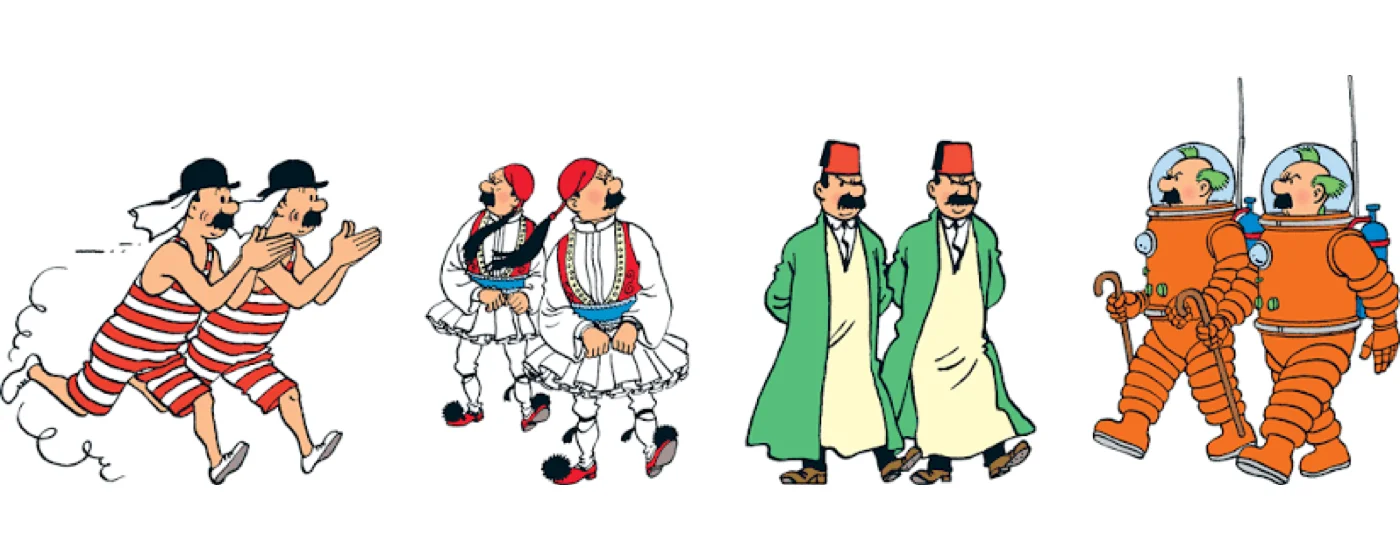 Acting
incognito across industries.
Acting
incognito across industries.
It makes more sense than trying to answer this question: what category do we fit in?
Are we an agency? A studio? Consultants? A dev/design shop? Strategists? Executants? AI advisors? A product studio? A thinking hub trying to find meaning? Yes. All of these at the same time, until you need something specific. Then we collapse into whatever solves your problem. That is what quantum particles do. That is what we do.
Brian Eno invented ambient music, produced Bowie and U2, and designed a card game for creative blocks. Feynman won a Nobel Prize in physics while picking locks, teaching, playing bongo drums, and drawing nude portraits. I’ve noticed the people & artists I tend to like, those, for me, doing the most interesting work, seem to follow their curiosity and instinct instead of a job title.
The old model is a slim jean in 2026
These categories do not fit because they were designed for a different era. One era that’s coming to an end. It is like putting on slim jeans in 2026 when fashion is all about wide pants. Until now, you had to hire an agency for your brand, a consultant for the strategy, a dev for tech, a sales consultant for lead growth, and a designer for the UX. Most of the time, having specialists with high level of knowledge in their domain would result in good outcomes.
The problem was everything around it. I can think of separate budgets, separate teams that do not communicate, endless meetings about nothing, someone being replaced by an intern with no idea of what you are talking about, PPT decks collecting digital dust, ego or corporate wars.
Or the worst-case scenario: an agency doing a job so bad it tanks the whole business, gets everyone fired but you can’t do anything because of internal politics. I’ve seen it happen, maybe you too. yikes!
So this model has limits and this is why we wanted to design our own. Be the change you want to see in the world (or something like that) they said. One fitted to what we believe is real now, focusing on authenticity and rewarding good work.
Our vision: values first, real human connections over social media posturing and doing business in a way we can look at without cringing before going to sleep.
Now, you might ask: what if I need a beautiful motion video from someone who knows this craft, or a website that can handle a million connections safely, or someone who can go on TV and speak about a product for an hour in a perfect British accent? Well yes it makes total sense.
That is why when we feel we cannot deliver the quality a client deserves, we activate our liquid network of videographers, designers, product managers, lawyers, and engineers. friends and ex-colleagues we met across Nepal, France, the US, China, Reunion Island, the Netherlands, and where we operate now: Spain and the Cyberspace.
We know these people. We trust them. They always deliver. That is the underdog advantage. Being small allows us to take the time to care about the quality, fair pricing, and doing business honestly like a small boutique.
Say hello to the tesseract. It does not bite. For now…
How this works, roughly
Our business identity and our personal identity should merge. What you read is not a “professional voice”, it’s us. The studio is the people. The people are the studio.
Being early-phase means we have no legacy clients warping our judgment. Being two people means the person on the discovery call is the person doing the work. These look like weaknesses on paper. They are a positioning choice. The tesseract, the lexicon, the weird references and easter eggs all over the website act as a filter. The clients who get it self-select. The ones who do not save everyone time.
As we said in our piece on the taste economy, anyone can ask AI to generate a thousand posts, today. But without vision, context, personality and experience, those posts are just noise. It will maybe work on the short term sure, but the tools will keep changing, your competitor will be able to copy you in a few seconds. What will not change is the need for someone who knows what to say and why. Context matters more than content. I wish more companies and people understood that.
The system behind that.
Our own AI systems run every day, with tools, skills and agents designed over months of solving our own problems. The system does the boring stuff and the tasks that can be delegated or where speed matters more than judgment. But the most important part stays with us: the thinking, giving meaning, connecting to our memories. The part an LLM cannot do because it has no way of experiencing anything. And no, putting an LLM on a small robot to experience the outside doesn’t work. (It’s fun tho I agree.)
Why a tesseract on a homepage
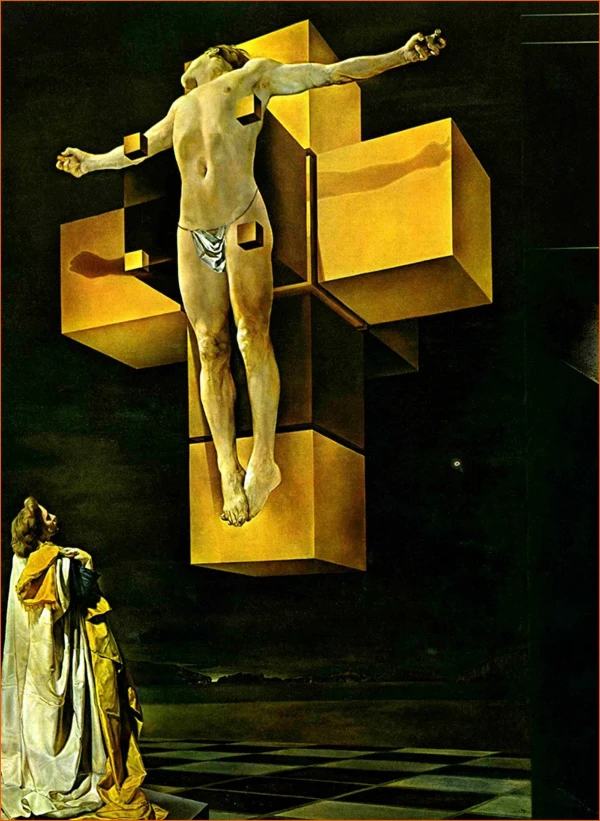 Salvador Dali, Corpus Hypercubus (1954).
Metropolitan
Museum of Art, New York. He did it first. We just added WebGL.
Salvador Dali, Corpus Hypercubus (1954).
Metropolitan
Museum of Art, New York. He did it first. We just added WebGL.
Now, the tesseracts. Finally, the title of this article.
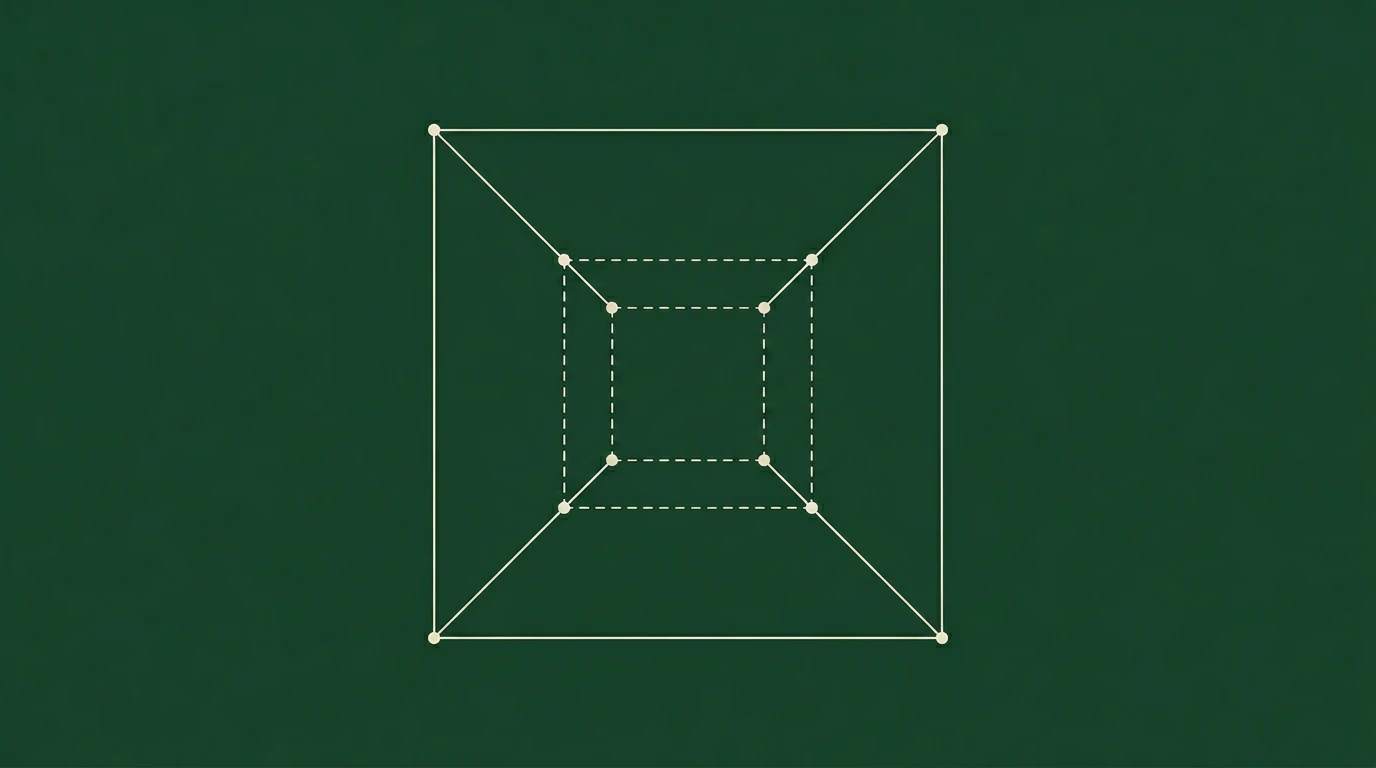
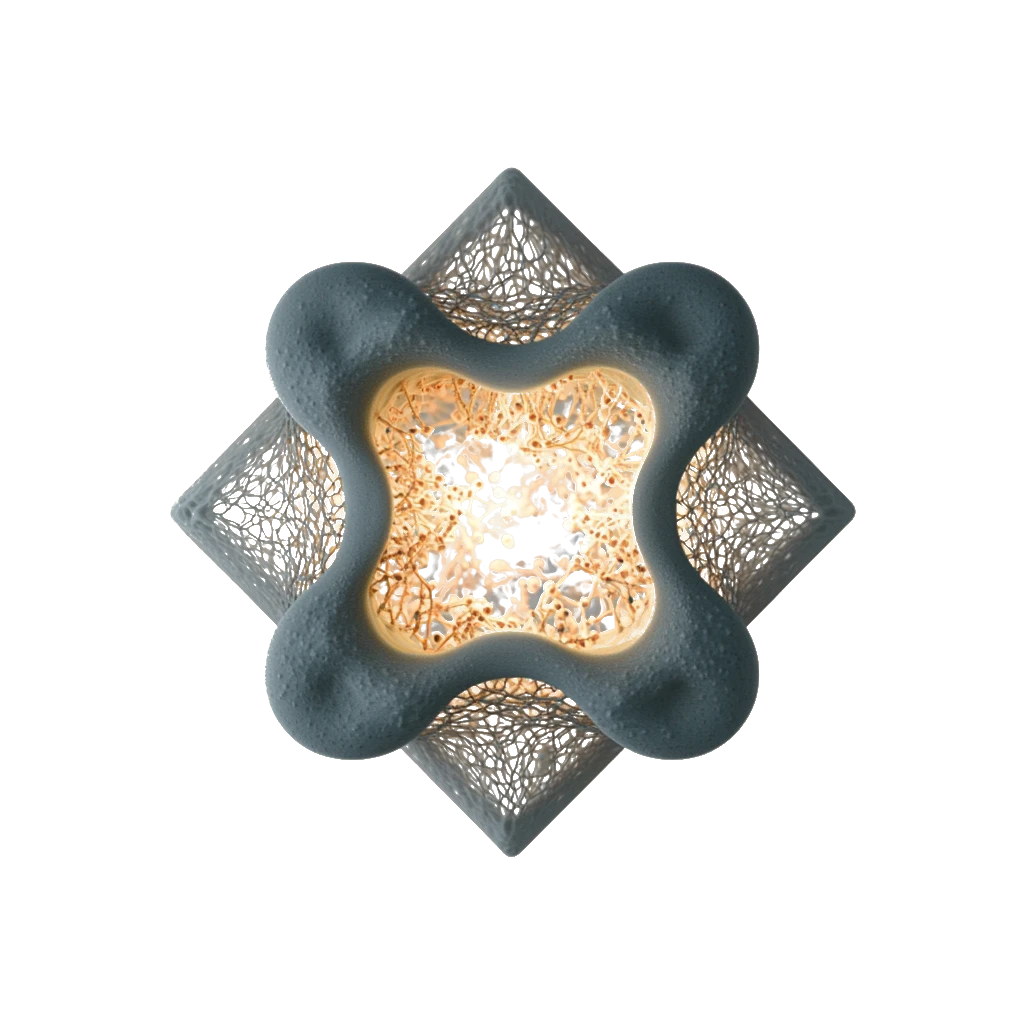
A tesseract is a shape, a cube that exists in dimensions we cannot directly perceive. The 3D projection you see on our site is a translation from a higher-dimensional reality into something our senses can process.
Salvador Dali, one of the many Catalan artists that inspired our work and attracted us to Barcelona, understood this. In 1954 he painted a Christ crucified on an unfolded tesseract: Corpus Hypercubus. Of course, as a painter, he knew that geometry could express what language could not.
We put tesseracts on our homepage for the same reason. This is our brand thesis rendered as geometry. It is a visual metaphor of what we do: we translate multi-dimensional strategy into something visible and tangible.
Like the tesseract that lives in interstitial space, between what you can see and what operates underneath, we live in a similar space: in the ampersand between salt & silicon, between the organic & the computed, between reality & simulation.
Like quantum particles, our work is alive. It is slightly unpredictable. It resists the sterile perfection of a rendered 3D object. Like a tesseract, it moves. It breathes. It is silicon that behaves like salt.
We are still early. The playbook does not exist yet but we can write it together. If this resonates and you want to work together, or if you just want to talk about tesseracts, you know where to find us. If you want to know who we are or explore the lab, those exist too.
Questions we get asked
What is a tesseract?
Take a cube. Now imagine that cube exists in four dimensions instead of three. You can’t see four dimensions (nobody can), so you project it into something your brain can process, the same way a shadow flattens a 3D object onto a wall. That rotating wireframe on our homepage, or the interactive one on our lab page, is one of those projections. A 4D object rendered in a 3D world, displayed on your 2D screen, processed by your 1D brain. Good luck.
What is a frontier studio?
A small team, two to five people, with AI infrastructure that lets them deliver at the speed of a bigger agency but with the taste and precision of a boutique. We started using the term in January 2026 when we created Salt & Silicon. A few months later, Stanford launched their 2026 CS 153 course with a “one-person frontier lab” project, which felt like validation. The model has no playbook. There is no manual yet.
Why use quantum physics as a brand identity?
In quantum physics, a particle exists in multiple states until you observe it. Then it collapses into one. We work the same way. Strategy, design, engineering, content, all running at once, until a client shows up with a specific problem. Then we collapse into whatever solves it.
The tesseract, the particles, the white hole on the homepage, all of that is the brand thesis turned into geometry. If you look at our site and think “what the hell is this”, the filter is working.