Startup marketing and positioning: For startups.
GTM sequencing, sales, AI and brand systems.
Directly with the two founders.

Startup marketing problem: Blurry positioning.Burning runway.
62% of Series A startups hit messaging misalignment within twelve months of raising.
The pitch that convinced investors assumed a buyer who does not exist at scale.
The work we do.
Growth, positioning, AI systems and brand design. Every engagement starts from the problem you have.

Language and positioning
ICP definition and messaging
- ICP definition: who switches to you, why and from what
- Messaging hierarchy: category frame, differentiation, value proposition
- Landing page rewrites calibrated to your ICP
- Pitch narrative: from what you launched to why someone switches
- Competitive positioning audit
Sales language
- Outbound sequence copy: cold email, LinkedIn, follow-up
- Demo script and objection handling
- One-page positioning document your sales team uses without the founder
- Proposal and case study templates
GTM and distribution
GTM sequencing
- Channel audit: where your buyers spend time
- Wedge ICP identification: who to target first, before expanding
- One-channel-first strategy with sequenced milestones
- Distribution plan tied to revenue targets, not activity metrics
- Compounding content through SEO, LinkedIn, newsletter and more
SEO and AEO
- Technical SEO audit
- AEO visibility check: how you appear in ChatGPT, Perplexity, Claude, Gemini...
- Topic clusters for category authority
- Content calendar: what to write and in what order
AI systems
Sales AI systems and governance
- AI-assisted prospecting, qualification and follow-up workflows
- AI readiness audit: where automation earns trust, where it erodes it
- AI systems map: tools, workflows and governance layer
- Implementation roadmap with named milestones, in working-document form
- AI governance policy: one page, usable by a team of six
- Tool audit: cut redundant subscriptions, identify the gaps
AI fluency for founders and content stack
- AI fluency for founders: how to use AI without losing the voice that closes deals
- AI-agnostic automation setup (Claude Code, n8n, Zapier, or custom)
- Prompt libraries that preserve your founder voice at scale
- Five-format weekly content system (one client cut production cost by 75% in month one)
- Editorial QA layer: which AI output earns its place in front of a buyer
- Monthly AI briefing specific to your stack and use cases
Brand and design
Brand identity and content design
- Brand identity: logo, wordmark, visual system
- Tone of voice and brand voice documentation your team can use
- Typography, colour system and brand guidelines designed for production speed
- Landing page design from scratch or full rebuild
- Pitch deck design with real art direction
- Visual assets: founder portraits, product shots, campaign imagery
Lead infrastructure and prototypes
- Lead nurture email flows from signup to demo
- CRM setup and automation (HubSpot, Attio, or your stack)
- Reporting dashboards: live pipeline, source attribution, conversion rates
- Working prototypes for investor demos
- Interactive dashboards for board presentations
Analytics and revenue ops
Lead analytics and attribution
- End-to-end funnel tracking across every touchpoint
- Attribution modelling: which channels and touchpoints drive revenue
- Conversion rate optimisation on the points that leak most
- A/B testing infrastructure and hypothesis backlog
- Session replay and qualitative layer
Revenue leak detection
- Revenue leak detection across all funnel stages
- Channel economics: CAC, payback period, LTV by channel and segment
- Cohort analysis and retention diagnostics
- Pricing experiments and segment analysis
- Monthly data-driven strategy
Proven patterns from fintech, SaaS and spatial web platforms.
Experiments where no playbook exists.
Three ways to start.
Most startups we meet fall into one of three situations. Pick the one that sounds like yours.

Audit
You suspect half your language is wrong. You do not know which half.
- Website, deck, outbound, social: all in
- Ranked list of where the language is breaking
- A specific map of where to start, ranked by revenue impact
You leave with clarity on where the message breaks and what to fix first. If the audit does not surface at least three specific fixes, we refund.
See the audit pageSprint
You know what you need. You need it live this month.
- One contained problem: messaging system, GTM sequence, content engine, or automation setup
- The sprint ends when the deliverable exists
- Credited against the retainer if you continue
A working system your team runs from day one.
Retainer
The work will compound. Your team will be using it after the month ends.
- Ongoing execution: content, SEO, distribution, systems, whatever the current highest-return move is
- Monthly cycles, no long-term lock-in
- We operate as the growth function, month to month
A compounding growth system. Cancel any time.
Work directly with the founders.

Diagnose first
We diagnose before we prescribe. The audit maps your current language, names where the message breaks and tells you what to fix first. One week. Specific output.
Align on the problem
We disagree when we see it differently. The founders who get the most from us want their assumptions challenged before those assumptions cost runway.
One thing goes live
A sprint is one problem, one deliverable live. A retainer is the system running month to month. You choose the scope after the diagnostic.
The work compounds
Positioning fixed in month one generates referrals in month six. Content seeded in week three drives inbound in quarter two. Your team keeps using the system after the month ends.
Founder evidence
Polkadot
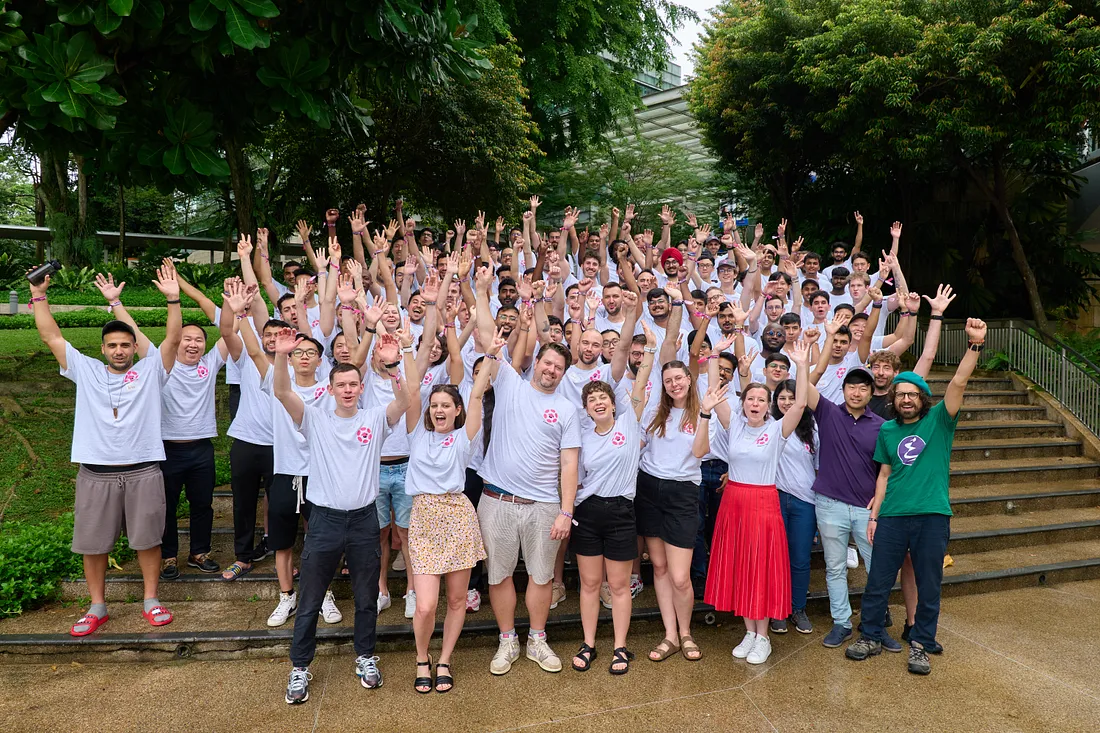
Blockchain academy with campuses in Berkeley, Cambridge, Switzerland, Indonesia and more. Positioning fix and GTM rebuild. Applications up 21%. Cost per acquisition down 56% across four continents.

METAV.RS
€3M raised, €1M ARR. Thomas led growth from early-stage through raise. Language architecture and GTM strategy reaching web3 and mainstream audiences at the same time.

RetinAI
Swiss medical-AI startup launching Discovery for Clinics at EURETINA Barcelona. Positioning and launch strategy tuned for ophthalmologists, optometrists and clinical buyers across 40+ countries. Product landed in front of the exact decision-makers.

Collaborators worldwide
A liquid network of specialists. The right person for the right stack, timezone and vertical. The founders stay on the work. We extend the team when the brief demands a specific skill.
Two founders. No account manager.
The people who diagnose the problem design the solution. Book a 30-minute call.
Bring your messaging. We will tell you where it breaks.

Before you ask.
We tried a branding studio after our seed round. We have a brand guide nobody reads. How is this different?
A brand guide nobody reads ends as a PDF in a Notion page. We design a language system the team can repeat without the founder in the room.
The test: can your sales team close without you? Can a new hire explain what you do in one sentence after one week?
When narrative debt clears, decisions compress. Messaging stabilises. Pipeline velocity rises. The guide comes out of the work as a by-product.
We have AI tools. Why would we pay for this?
Eighteen months of blurry positioning costs more than the audit. A founder post-raise with unclear messaging spends runway on the wrong traffic, the wrong channel, the wrong ICP.
AI tools accelerate the blurry system you already have. We add the editorial layer that chooses which of the infinite outputs deserves a buyer, which voice holds and which one drifts.
Every founder in 2026 has generation. The constraint is judgement. One client running five content formats weekly cut production cost by 75% in the first month. The voice stayed intact.
What does a startup marketing studio do?
A startup marketing studio handles the positioning, messaging and growth infrastructure a founding team cannot set up alone at speed.
This covers language architecture (ICP definition, messaging hierarchy, pitch narrative), GTM sequencing, sales AI systems, content and brand design and lead analytics.
Salt & Silicon scopes every engagement around the actual situation rather than a fixed service list. Most post-seed founders need a team that crosses disciplines without the overhead of an agency.
We are pre-revenue with under €500K raised. Is this too early?
It depends on the problem. If you cannot explain what you do in one sentence, the answer is no.
Clear language before paid acquisition costs a fraction of what blurry language costs over 18 months of wrong-audience traffic. The founders who should wait are the ones who have not yet spoken to 20 customers: the language for your positioning comes from them, not from us.
How do we know this will work before committing to a retainer?
We start with a paid pilot. The Discovery audit is a full diagnosis of your current assets.
You leave with a specific map of where the language is breaking and what to fix first. If the audit does not surface at least three specific fixes, we refund.
If it does and you want to continue, the cost credits against the sprint. You are never locked in beyond the month you are in.