
The generalist problem
I spent years believing my brain was wired wrong, i’m starting to think it’s the opposite.
I would read something about Jung, then try to learn something about Pep Guardiola’s positional play for a Football Manager game, then connect these both things during a run to something i lived on a volcano in Reunion Island ten years ago, leading to a new idea. People would look at me like I was scattered and “unfocused”.
Recruiters (some of them may be reading this 👋) that often didn’t have the same marketing background, would announce me after 5 interviews and 2 unpaid take-home assignments that I am ideal for the role, EXCEPT that I wasn’t “specialised enough” in “SEO” or “paid ads”or “enter whatever here”.
“We’re so sorry, but you’re too much of a generalist” I kept hearing. Argh! Well I got so frustrated and sometimes even in despair as this never made sense to me, both from a human and business POV, but I believed them for a long time.
ADHD as systems thinking
ADHD means your brain’s filter lets everything in, idea A to idea Z sometimes skipping everything in between. School punishes that, corporate punishes it harder, you learn to mask it or feel bad about it. I did both.
It started to change when in 2023 i started wiring these new tools into how I think and how I create, so that what was supposedly wrong with me turned out to be a superpower. Little by little I stopped losing time on the tasks that made me crazy before and where I was losing most of my time (chaotic inbox, file management, crawling the web to find some intel just to be distracted by a funny cookie banner or whatever shiny new thing I would see).
So now that I noticed this pattern, it’s way easier to understand how I think in systems: how a partner connects to a sales pipeline, how it connects to a design decision that connects to code and OPS and so on. Sometimes all in the same thought! These patterns even show up before I even ask for them naturally. Therefore I don’t see that as “overthinking” or an issue anymore. Just… thinking.
I had no word for this until I found a Stanford course that named it.
Stanford CS153: the one-person frontier lab
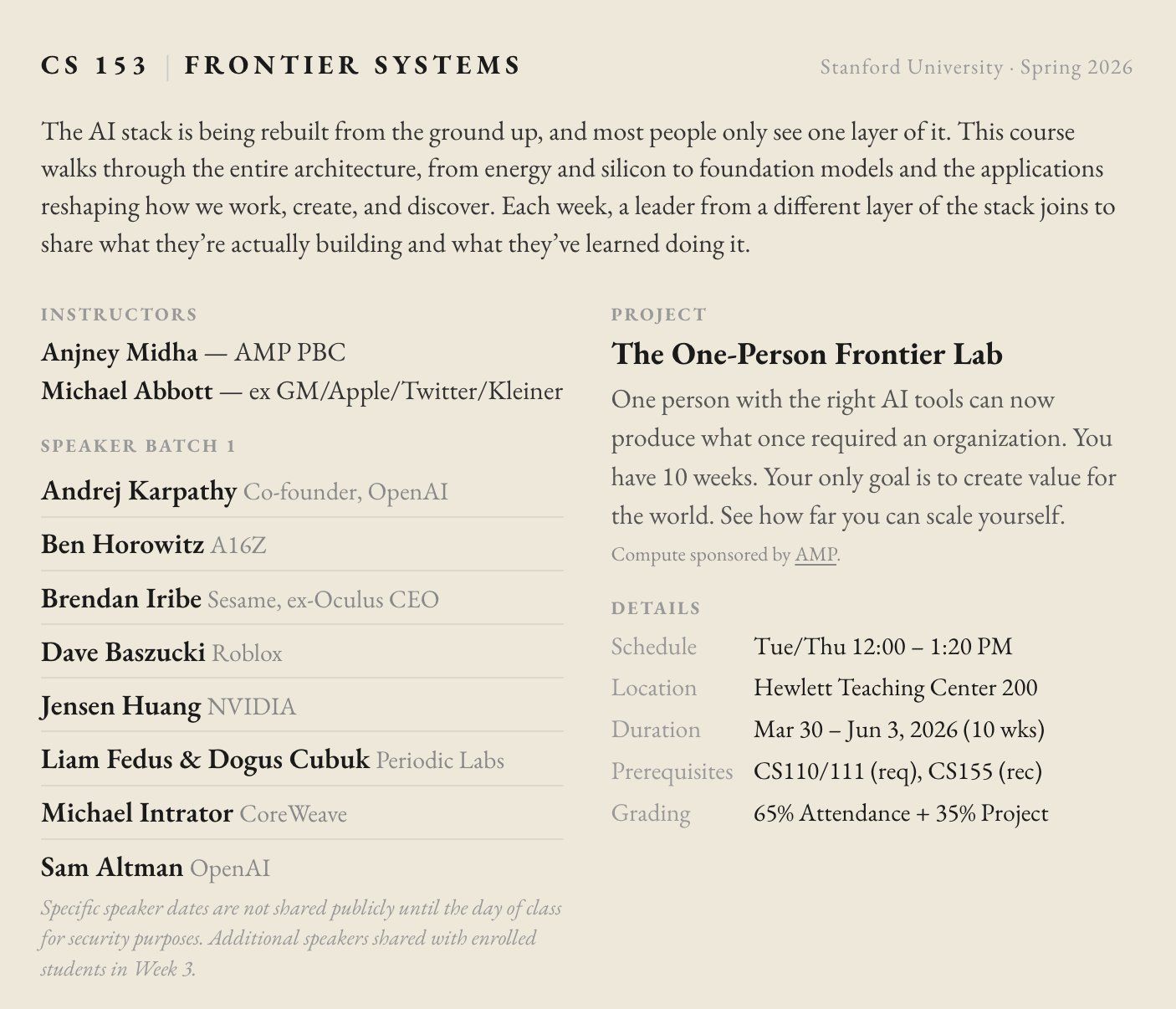 Stanford CS153: Frontier Systems, Spring 2026. The One-Person Frontier Lab project.
Stanford University launched the third edition of their CS153 course: Frontier Systems. Hallelujah!
The course has been running since 2024 with speakers like Sam Altman, Jensen Huang, Andrej Karpathy, Ben Horowitz. But this edition changed the student project. Previous editions were “design and deploy an AI agent” and now it’s “the one-person frontier lab”.
They bet that one person with the right tools and hard work can produce what once required a full organisation. Students have 10 weeks to see how far they can scale themselves.
Stanford went from “create a tool” to “become the organisation” and by doing so, formalised exactly why we created Salt & Silicon few months ago.
Building our own frontier lab
Indeed, my cofounder Desh & I have been running that experiment since January from Barcelona.
We’re only two founders. We designed our own infrastructure, personal file system, agents that extend our thinking on marketing, design, engineering, sales, ops, QA & more. We have our own custom Claude skills, Obsidian vaults, all grown by using it every day for months (or even years). We used these to design our entire brand, research, website and growth system in only a month, that kind of scope would honestly take a team of five a few years back, from experience.
We started to understand that we live in a permanent tension between reality and what I call the “simulation”. We use AI daily while we think most AI output is garbage. Both true, same day, sometimes the same hour.
So we discovered what we were searching for was meaning. When we design a brand for a client: does this say something that belongs to them? Or could their competitor put their logo on it and nobody would notice?
TBH we’re still figuring it out, as everything is moving crazy fast and this model has no playbook that I’m aware of, therefore it might evolve all the time.
Anyway I’m glad I’ve found that course exist, even tho I can’t attend it. There are days where creating something with no name feels lonely, you feel like people nod politely when you explain what you do, but file you under “oh a new AI agency” (I don’t think we are one). Makes you wonder if you’re early, crazy or totally wrong (maybe all three at once).
But then Stanford calls their new project “Frontier Lab” with these Silicon’s Valley CEOs while you named your own lab “The Salt Valley”, it gives a lot of motivation on the direction. Might also just be confirmation bias but still good for the troop morale.
The world of work is changing and this studio is our response. We do strategy, brand, systems, coaching for brands, plus content and products reflecting on the philosophical shift that comes with these new tools.
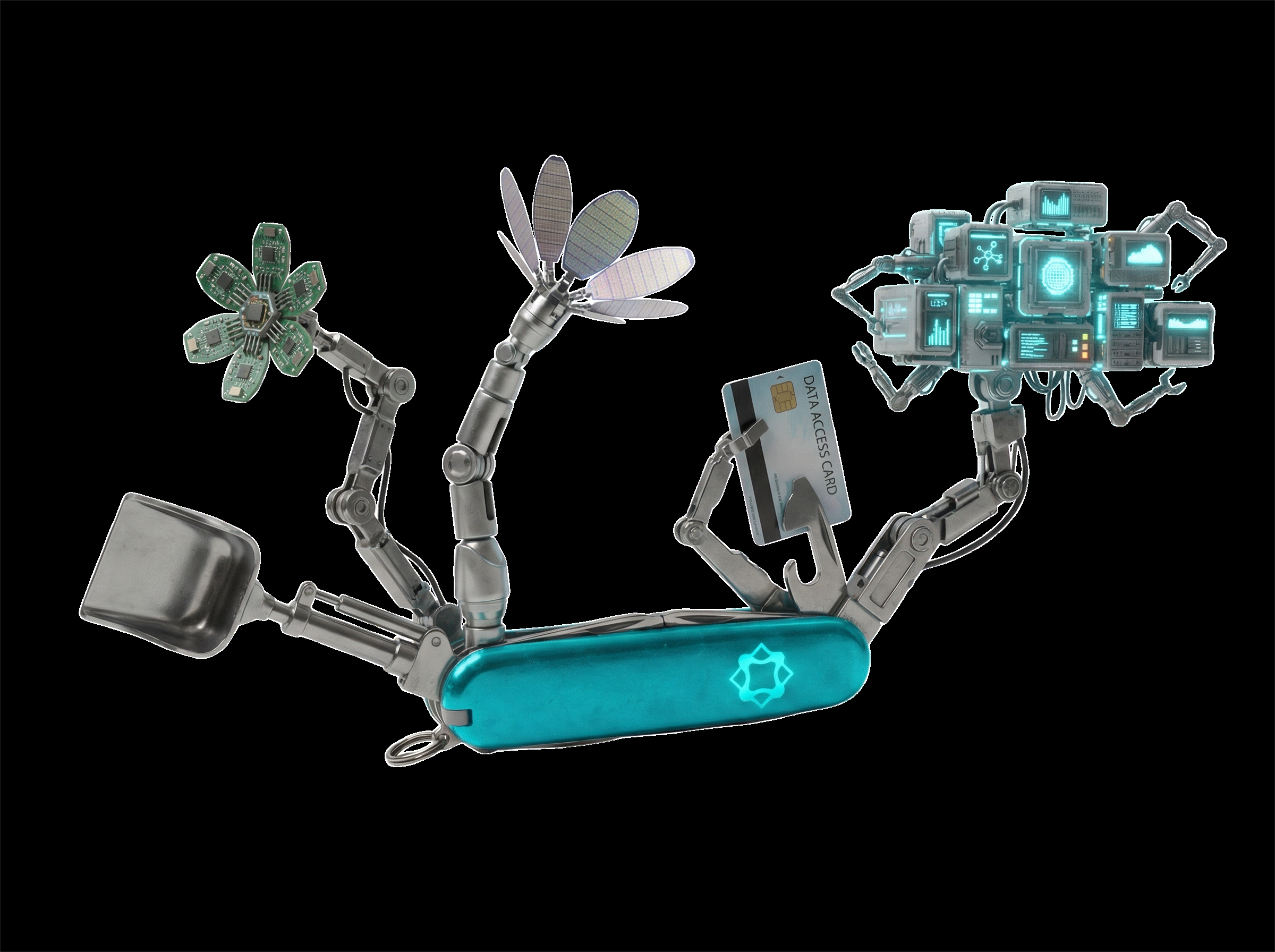 The generalist’s toolkit: orchestrating systems across domains.
Want to go deeper? Read our essay on the 5 skills you need in the taste economy. Pattern recognition across domains is the generalist superpower.